
"Lanzhou's lush greenery is hard-won, and behind it lies decades of relentless advancing of greening construction."
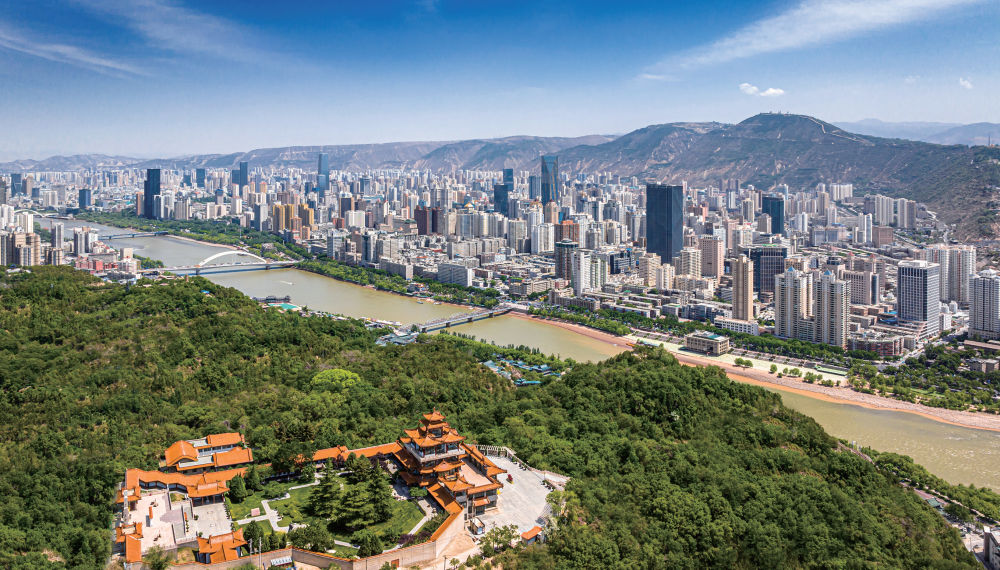
May 29, 2025, Lanzhou scenery
In summer, Lanzhou is lush and green on the northern and southern mountains, like two emerald ribbons encircling Jincheng. On the Luojiu Highway, cyclists weave through the shade of the trees; Inside the Peony Garden of Jiuzhou Terrace, visitors are intoxicated by the sea of flowers.
The Yellow River flows through nine provinces and regions, but only Lanzhou is the provincial capital city where this mother river flows through the city. The Yellow River's millions of years of scouring and cutting have formed many gorges such as Bapanxia, Sangyuan Gorge, and Daxia, which are distributed in a staggered manner with the Lanzhou Basin and Shichuan Basin; The main urban area is flanked by Gaolan Mountain and Baita Mountain to the north and south, with the Yellow River running west to east across the entire area, forming a unique urban framework of "the Yellow River running through the city, embraced by two mountains."
"Lanzhou's lush greenery is hard-won, and behind it lies decades of relentless advancing of greening construction." Ren Zhibin, Deputy Director of the Lanzhou Northern and Southern Mountains Ecological Development Center, told Outlook Oriental Weekly. His career has been closely intertwined with the fate of this mountain forest for nearly 33 years. Since graduating from university in 1993 and being assigned here, he has witnessed the land's transformation from "endless yellow sand" to "lush greenery," and personally experienced the iterative upgrade of governance models from manual pioneering to engineering and refined management.
"Carrying Ice for Afforestation"
Strolling along the northern and southern mountains of Lanzhou, the dense irrigation pipes wind along the slopes, with pumping stations operating in an orderly manner. Yellow River water is precisely delivered to each mountain through multi-stage pumping and irrigation engineering, nourishing the forests covering the hills. Nowadays, such engineering water diversion scenes have long become the norm in Liangshan's greening efforts. Maintenance personnel regularly inspect and repair pipe networks, clean reservoirs, and safeguard this green area in a scientific and efficient manner.
Tree planting in Lanzhou is extremely difficult, mainly because the annual precipitation is scarce. As a temperate continental climate city, its annual precipitation is only about 300 millimeters, far below the "forest survival line" of 400 millimeters. Moreover, being located at the junction of the three major plateaus—the Qinghai-Tibet Plateau, the Inner Mongolia Plateau, and the Loess Plateau—the soil is thin and water retention is weak, making it difficult for seedlings to maintain their roots.
Gaolan Mountain is the highest point in Chengguan District, with high altitude, steep slopes, poor soil, and scarce water resources. It was once the biggest bottleneck restricting regional greening and a particularly tough "hard nut" in Lanzhou's ecological construction. Speaking about his early experience planting trees, Ma Yongdong, who has over 20 years of forest protection experience, remarked that the greening conditions on the northern and southern mountains are extremely harsh. Due to the lack of basic irrigation facilities, the saplings survive entirely by natural precipitation.
Therefore, whether it was early tree planting or current forest land maintenance, artificial irrigation must be relied upon to replenish moisture, which has put Lanzhou's greening efforts under severe natural constraints from the very beginning.
Among the Gansu Provincial Archives, a yellowed archive stands out strikingly—the 1958 notice forwarded by the Office of the Tree Planting Command of the Gansu Provincial People's Committee, titled "Two Notices from the Lanzhou Agriculture and Forestry Bureau on Carrying Ice to Watering Trees and Collecting Tree Seeds." In the 1950s, the northern and southern mountains were still barren and barren, and there was a local legend: "One tree on Gaolan Mountain, seven trees on Baita Mountain." Here, the land is dry with little rainfall, the soil is poor, and the survival rate of seedlings is extremely low. To resist wind and sand and protect the industrial stronghold of Northwest China, Lanzhou responded to the call to "green the motherland" by launching a mass afforestation movement in the northern and southern mountains. To keep the saplings alive, Lanzhou people came up with a "clumsy method"—carrying ice up the mountain.
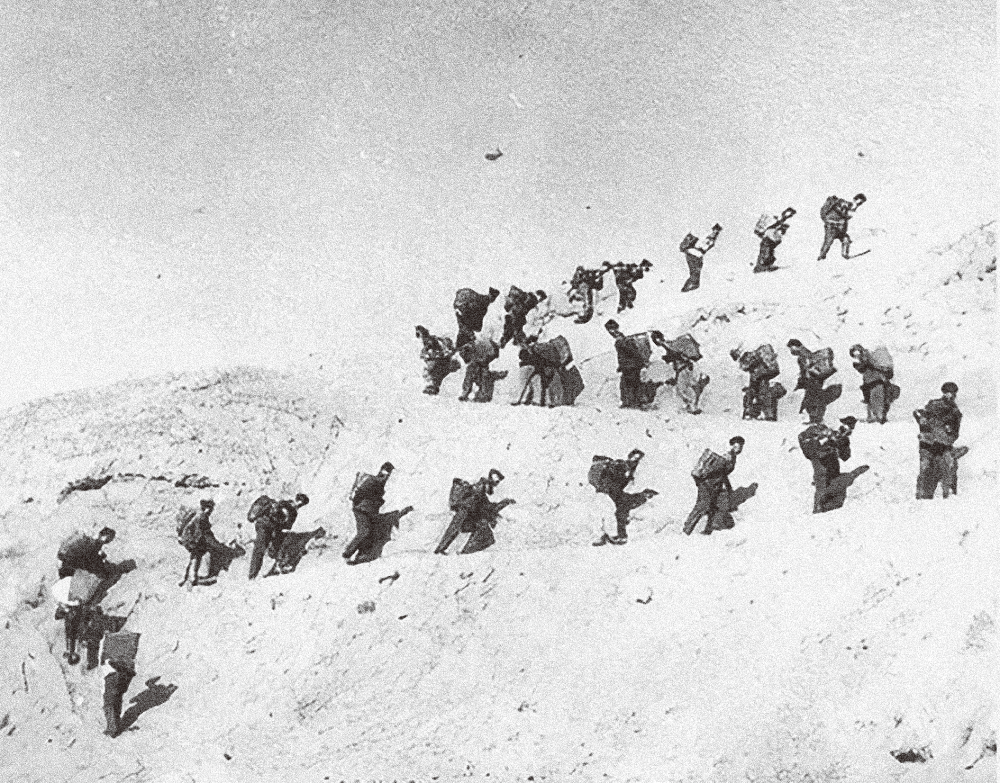
In the 1950s, Lanzhou people carried ice up the mountain to engage in greening (image source: China Gansu Net)
Ren Zhibin told Outlook Oriental Weekly about those years of "carrying ice to create forests": "When the ice froze in winter, the government mobilized cadres and the masses to carry ice blocks from the Yellow River up the mountain and bury them in tree pits dug in advance. When the ice and snow melt the following spring and moisture seeps into the soil, the saplings are planted. ”
"Carrying ice in winter, and carrying water in summer." Ren Zhibin added. In summer, when trees enter their peak growth season and urgently need water, local rainfall is severely insufficient. Cadres and staff carry water from the Yellow River up the mountain, spoonful by spoonful to water the seedlings.
Besides water shortages, the soil conditions are also extremely harsh. The mountains often have exposed rocks, so people had to carry soil up the mountain by hand, replace the soil in the tree pits, and then dig pits and plant them in the icy snow. But it is precisely this resilience, like the foolish old man who moved mountains, that Lanzhou people have gradually sown green seeds on barren hills, laying a solid foundation for future ecological development.
Data from the Lanzhou Northern and Southern Mountains Ecological Development Center shows that since 1999, Lanzhou has secured 460 million yuan in national funding to implement a 330,000-mu environmental greening project covering the northern and southern mountains. After 2003, the project to reforestate barren hills and converted 110,000 mu of farmland back to forest was successively completed, as well as the fourth phase of the "Three North" project. In just a few years, the greening area has expanded outward from the main urban area, extending all the way to the 70-kilometer corridor along Lanzhou Zhongchuan Airport.
The ecological value is 11.169 billion yuan
The 152-kilometer urban area through which the Yellow River flows through Lanzhou is an important part of the national western ecological security barrier zone and plays a pivotal role in ensuring ecological security in the Yellow River Basin. "Greening the northern and southern mountains of Lanzhou is a key part of building an ecological barrier in the upper reaches of the Yellow River, and is crucial to the ecological security of the entire basin." Ren Zhibin told Outlook Oriental Weekly.
From the initial tree-planting pilots, to the nationwide contracting in the 1980s, and then to the advancement of engineering after 2000, the area of artificial afforestation between Lanzhou's northern and southern mountains ultimately reached 620,000 mu. However, maintaining 620,000 mu of forest land is also a massive undertaking.
"Water at least four times a year." Ren Zhibin did the math: each irrigation required pumping water from the Yellow River to the mountain top through multi-level pumping stations, then distributed to various hills through dense pipelines. Currently, there are about 2,000 maintenance personnel in the northern and southern mountains, responsible for pipeline repairs, daily irrigation, and forest fire prevention. The considerable maintenance costs are a severe challenge facing Lanzhou's greening.
But technology is changing things. At Jiuzhou Terrace in Beishan, Lanzhou, our reporter saw that in some newly renovated areas, traditional sprinkler irrigation is being replaced by more water-efficient drip irrigation. "Sprinkler irrigation requires 100 cubic meters of water per mu per year, while six drip irrigations only require 80 cubic meters, and it can precisely reach the roots." Ren Zhibin pointed to the shiny galvanized pipes and said, "Technology is constantly evolving, and we are exploring reclaimed water utilization to further reduce costs." ”
In recent years, following the principle of starting with easy and then with difficulty, and with urgent matters before easing, the northern and southern mountains have been upgraded and irrigated by 50,000 mu. By 2025, the irrigation water for 5,000 mu of forest land on Changwa Mountain Mianshan in Chengguan District will be replaced by recycled water from the Yan'erwan Sewage Treatment Plant. This water-saving measure achieves a win-win for ecological protection and resource recycling.
According to data from the Lanzhou Northern and Southern Mountains Ecological Development Center, after more than 70 years of greening construction, the two mountains have formed a complete system of artificial ecology, infrastructure, ecological culture, and management and protection.
In terms of artificial ecosystem construction, 160 million trees of various species have survived, with 424 species of plants from 75 families, and 76 common vertebrate species. In 2025, according to an assessment by Lanzhou University, the comprehensive value of the ecological service functions of the two mountains will be 11.169 billion yuan. This figure highlights the ecological benefits of greening the northern and southern mountains in Lanzhou and provides a model for ecological management in the arid regions of Northwest China.
In terms of infrastructure system construction, 139 power pumping and irrigation projects have been built, 389 water supply management stations and pump stations, and 751 storage and regulation tanks; There are 41 forest fire prevention checkpoints, lookout towers, and meteorological stations, with over 600 kilometers of forest roads.
In terms of ecological and cultural system construction, more than 20 forest parks have been established in the northern and southern mountains, with over 80 leisure and sightseeing bases, and the number of scientific, educational, and recreational services reaching 36 million people annually.
Thanks to solid achievements, the greening work of Lanzhou's northern and southern mountains has been successively awarded titles such as the "Organization for Forest Attention Award," "National Advanced Unit for Afforestation Work," "National Advanced Collective for Greening," "National Advanced Collective in the Forestry System," and "National Ecological Culture Demonstration Base."
Green nourishes the heart
Lanzhou divides the management of the northern and southern mountains into four stages: the 1950s and 1960s were called the "Carrying Ice and Water Carrier" initial period; the 1980s and 1990s were the "universal contracting" construction period; after 2000 was the "engineering" expansion phase; and since the 18th National Congress of the Communist Party of China, the "high-quality development" enhancement period.
"In the fourth phase, we not only pursue 'greening,' but also 'becoming beautiful' and 'enjoying it.'" Ren Zhibin pointed toward Jiuzhoutai Forest Park and said that suitable forest land is gradually being transformed into forest parks, improving roads, pavilions, and other infrastructure to provide citizens with places for leisure and tourism.
From "building green" to "enjoying green," this is a shift in concept—an upgrade in Lanzhou's ecological governance from "ecological first" to "ecological benefiting the people," making green truly a universal benefit for people's livelihood.
"The trees across the street don't look very tall; they were planted after 2000 and have grown like this in over 20 years. Most of the lush trees we see on Xujiashan and Baita Mountain were planted before 1960, nearly 70 years ago. Ren Zhibin told Outlook Oriental Weekly.
Within the rings of these trees are engraved the resilience of the Lanzhou people. From the shoulder and shoulder of "carrying ice up the mountain," to the vigorous nationwide participation, and then to scientific and precise engineering management, Lanzhou's greening history is a tale of struggle against harsh natural conditions. It does not have the luck of a "natural forest"; it relies on generations of sweat, wisdom, and faith "nurturing" it.
Entering the new era, Lanzhou has scientifically carried out large-scale land greening, fully committed to the tough battle of the sixth phase of the "Three North" projects, and fully implemented the precise quality improvement action for the two mountains forest. By 2027, Lanzhou aims to complete ecological restoration and land greening on 240,000 mu, with a greening rate of 73.3% for the two mountains. At the same time, following the overall layout of land greening of "three green corridors, two mountains, and multiple points," a forest park system with a rational layout, clear theme, distinctive features, and coordinated development will be created.
Entering Xujiashan National Forest Park, you are greeted by lush forests, including local drought-resistant species such as sand jujube and red willow, as well as northern drought-resistant seedlings donated by Inner Mongolia, juniper, North China larch, and Hebei arborvitae. Most of the trees have grown for sixty or seventy years, with lush branches and leaves, layered over the hillside.
The park's infrastructure is gradually improving, with gentle walking paths, antique-style pavilions, and platforms for people to rest and enjoy the scenery. From a high vantage point, one can clearly see the Yellow River flowing through the city, while the distant Lanzhou urban area stretches out and narrow, with the greenery of the northern and southern mountains and the emerald waves of the Yellow River reflecting each other.
In recent years, Lanzhou has adhered to the principle that ecology benefits and serves the people, upholding the principle that a good ecological environment is the most inclusive welfare for the people. Relying on the existing forest resources of the northern and southern mountains, aiming to maximize forest functions, it integrates high-quality resources, cultivates ecological products, builds a number of premium scenic spots, continuously raises the grade and taste of forest parks, allows citizens to conveniently share the greening achievements of the northern and southern mountains, brings forests into the city, and lets cities embrace the forests, creating a green Lanzhou where humans and nature coexist harmoniously.
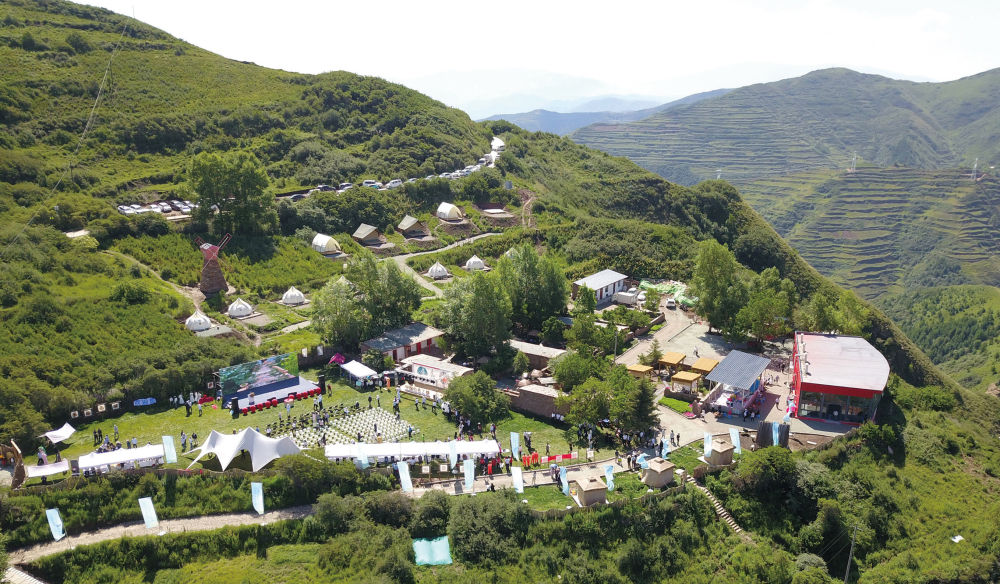
A wild luxury campsite in Hutan Village, Xiguoyuan Town, Qilihe District, Lanzhou City (Photo by Fan Peishen)
Starting from 2025, Lanzhou will use four years to consolidate and upgrade the two national forest parks of Xujiashan and Shifogou, and continuously improve the construction level of the four provincial forest parks—Wuyishan, Lanshan, Xigu Nanshan, and Guanshan—while advancing the construction of four provincial-level standard forest parks—Renshou Mountain, Jiuzhoutai, Daqingshan, and Shenjialing—to build a forest park system with a rational layout, distinctive themes, distinctive features, and coordinated development.
At the same time, relying on the construction of the ten major forest parks, the city actively guides the development of new business models such as forest wellness and eco-tourism, explores new models of "forest maintenance with forests," and develops diversified projects such as "under-forest economy, eco-tourism, and wellness industries." This effectively broadens the practical path for transforming lucid waters and lush mountains into invaluable assets, achieving a win-win integration of ecological beauty and industrial prosperity, and providing new ideas for the integration of ecological governance and industrial development in Northwest China. (Reporter Jian Hongni)
(This article was published in Outlook Oriental Weekly, Issue 11, 2026, Issue 960)