
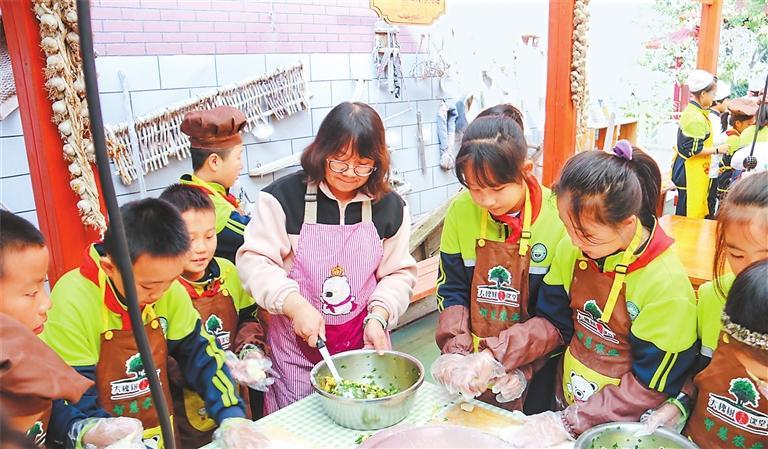
How can we break the limitations of books and bring knowledge to life? How can we fully tap into each child's potential?
Faced with these questions, Lanzhou's primary schools offered different answers: from school-based curricula rooted in local and nature, to "flexible class system" with full participation from all members, and to resource linkage through "school-library collaboration" and "home-school co-education," schools are breaking the boundaries of traditional classrooms, building a "comprehensive" educational ecosystem to promote students' all-round development.
National Defense Education: Sowing Red Seeds
At the start of this spring's new semester, Wanli Primary School in Anning District, Lanzhou City, focused on the important "first week of semester" by organizing a series of national defense education activities for all students, cultivating their patriotism and awareness of national defense.
In recent years, Wanli Primary School has insisted on integrating national defense education into the entire daily teaching process, building a comprehensive and multi-level national defense education system that includes classroom knowledge explanation, outdoor military experiences, red story presentations, and national defense skills practice.
He Jing, principal of Wanli Primary School, introduced that the school offers differentiated national defense courses tailored to the cognitive characteristics of students at different grade levels: grades one and two focus on national defense enlightenment, emphasizing the cultivation of discipline and rule awareness; Grades 3 and 4 focus on popularizing military knowledge, subtly cultivating students' national defense awareness; Grades 5 and 6 focus on strengthening national security knowledge education and national defense practical skills training, achieving normalized advancement of national defense education.
Wanli Primary School also periodically invites instructors from the National Defense Education Base and veterans to visit campus for military skills teaching and sharing red stories. Under their guidance, students diligently studied military boxing and carefully choreographed flag language exercises, participated in class presentations and presentations, enhanced their physical fitness, and reinforced their sense of collective honor, discipline, and responsibility. "When the children run morning exercises, their gathering speed noticeably increases, and their lines and formations become more orderly." He Jing said.
Lanzhou Dongjiao School integrates national defense education into physical education and moral education, offering a series of courses and activities. Dai Lifei, Director of the Academic Affairs Office at Dongjiao School, said the school values students' physical and mental health, offering related courses and activities to cultivate healthy, resilient, and courageous young people.
Over the years, Dongjiao School has invited active-duty military personnel to participate in flag-raising ceremonies and showcase military skills at important times such as the first lesson of school and Army Day; When hosting artistic events such as the "June 1st" cultural performance, the school invites soldiers and students to perform together; During holidays such as Spring Festival and Army Day, the school encourages students to write letters to border defense soldiers, building a communication bridge between students and border soldiers; Each class also has a PLA counselor who shares revolutionary stories or personal experiences during class meetings......
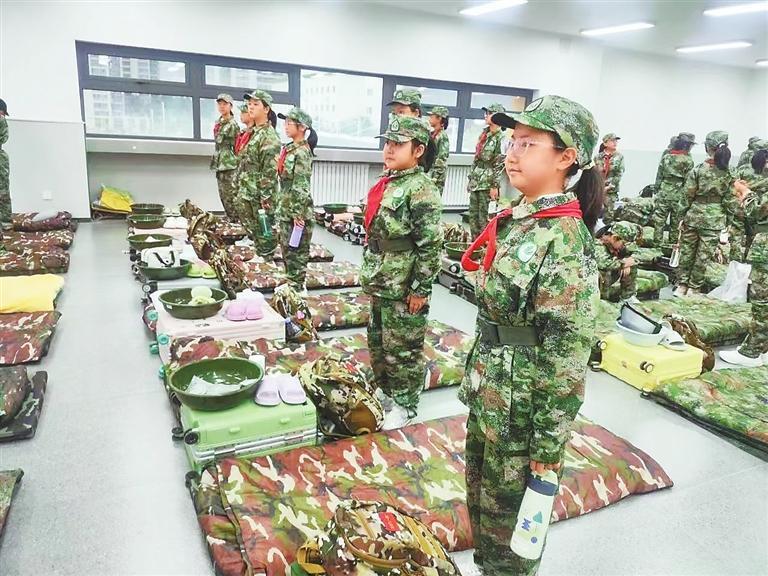
Dongjiao School also regularly organizes military training and comprehensive practical activities for senior students to enhance their willpower and sense of collective responsibility.
Last fall, sixth-grade students at Dongjiao School underwent a week-long military training at the Future City branch. Back at school, the children still excitedly discussed their feelings during military training: "I learned military boxing." "I learned to swim and gained a lot." "My constitution and endurance have both improved." "Everyone working together to bring honor to the class is something to be proud of." ……
Zhao Yating, homeroom teacher and Chinese teacher of Grade 6 Class 5, told reporters that during military training, teachers and children ate and lived together. Seeing the children change from relying on teachers to gradually becoming independent, she also discovered each child's shining qualities. "Many children show a fearless attitude and a proactive attitude toward learning during military training; After military training, the children's sense of discipline and teamwork has become stronger, and more and more students are actively participating in class work and helping others......
Special Courses: Learning Through Doing
In recent years, Lanzhou's primary schools have leveraged the surrounding campus resources to develop a series of uniquely distinctive school-based curricula, breaking the boundaries of traditional classrooms and allowing children to step outside the classroom and learn through daily life.
Recently, sixth-grade students at Yanning Road Primary School in Chengguan District attended an interesting math class at Yantan Park.
Under the guidance of teachers, the children independently designed themes such as "Exploring Boat Rental in Yantan Park" and "Cylinders and Cones in the Park," integrating boat rental problems, spatial geometry, and proportion problems into their curriculum practice and producing lesson reports. "Some students, after completing their course reports, said that they used to think math was just about doing problems, but now they realize math can solve many problems in daily life." Guo Tong, principal of Yanning Road Primary School, said that students' feelings are the best echo of integrating education into daily life.
In March last year, Yanning Road Primary School utilized the ecological resources within Yantan Park, integrating moral, intellectual, physical, aesthetic, and labor education to launch a series of "ecology+" courses, breaking the limitations of textbooks and allowing children to step beyond the classroom boundaries and experience life.
Guo Tong said that Yantan Park, as a teaching venue with diverse resources in culture, history, nature, and ecology, can cover almost all courses on campus: in ideological and political classes, children inherit their patriotic feelings through the park's historical culture and heroic stories in themed sculptures; In Chinese class, the children recorded real experiences in writing, turning the words in the text into real life stories before them; In math class, children use measurements and data to solve real-world problems; In English class, children use English to tell stories from their hometowns, transforming language learning from virtual scenarios into real communication......
This New Year's Day, Yanning Road Primary School held the "Ecological New Year?" The "Children's Heart Building a Home" ecological curriculum achievement exhibition will display children's observation diaries, nature notes, paintings, activity photos, research reports, and more. "At first, the children's essays only showed 'the leaves are green,' but by the end of the term, they could write 'the veins of the leaves are like rivers on a map, with fine serrations on the edges.' This leap in observation and expression is something no standardized test can measure." Guo Tong said.
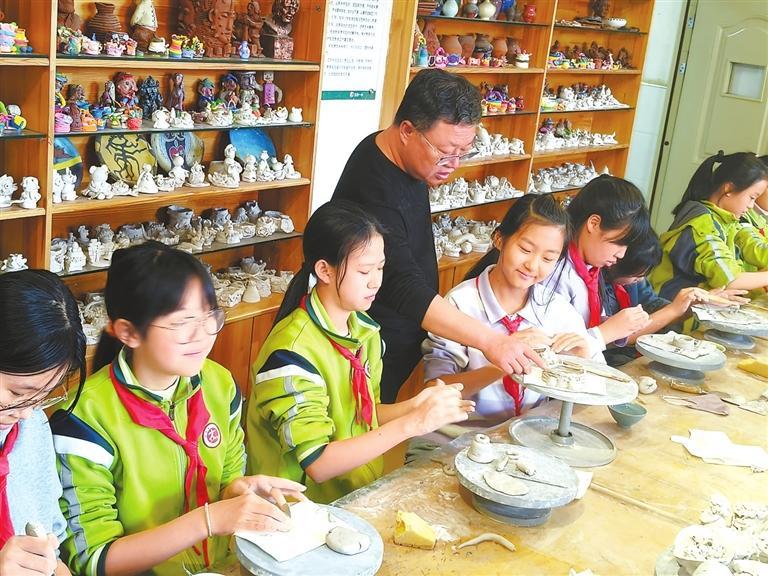
Entering Lanzhou Fulongping Primary School, two rows of unicycles are neatly arranged on the playground, with practice classrooms on the right side including the maintenance workshop, carpentry workshop, sugar painting classroom, and grass art weaving workshop. Passing through the teaching building, multiple functional areas such as ideological and political classrooms, planting areas, animal breeding areas, and fruit and vegetable processing areas are all fully equipped. "Students can participate in various practical activities without leaving the school gate!" said Wang Daobin, principal of Fulongping Primary School.
Life is education. Since its founding, Fulongping Primary School has been based on the natural ecological foundation of the slopes of Gaolan Mountain, focusing on "Green Living, Happy Growth," and has developed a "natural growth" curriculum system, striving to cultivate students into well-rounded and individualistic individuals—Chinese classes allow students to experience the artistic conception and connotations of traditional culture through traditional farming songs and landscape poetry, enhancing reading and expression skills; Math classes use the calculation of the twenty-four solar terms and traditional agricultural product statistics as material to integrate mathematical knowledge into daily life; Science classes explore traditional farming wisdom and the scientific principles of traditional tea making; The unicycle course allows children to master traditional skills through step-by-step practice and learn simple maintenance skills such as tire inflation and tightening pedal screws......
Fulongping Primary School also offers nearly 20 specialized courses such as "Dragon Kids" as a guide, speech and eloquence, paper cutting, and sugar painting, achieving all-round development in morality, intelligence, physical fitness, aesthetics, and labor.
Ma Zixuan, a sixth-grade student, has chosen paper-cutting courses for two consecutive years. "The butterfly I cut from teachers and classmates all said it looks good, and I feel a sense of accomplishment!" Ma Zixuan said that at school, she not only learned paper-cutting but also successfully grew chili peppers under the teacher's guidance. Observing the growth process of chili peppers made her realize how hard food is to come by.
Club activities: Discover each child's potential
Campus clubs are an important vehicle for campus culture construction. In recent years, primary schools across Lanzhou have actively organized and carried out various distinctive club activities. Club activities balance ideological value, artistic value, knowledge, and fun, enriching students' extracurricular life and providing a platform to showcase talents.
Recently, when reporters visited Fuli East Road No. 1 Primary School in Xigu District, senior students confidently demonstrated their tricks during the unicycle club activity, while the younger students were learning how to get on and off the vehicle under the guidance of their teachers.
Fifth-grade student Li Zimeng is already a "veteran member" of the unicycle club. It took her two years to go from being "afraid to tremble" to effortlessly demonstrating tricks. She said, "I really enjoy this sport and will continue to learn more riding techniques and perform moves from my teachers." ”
Shi Yanlong, Deputy Director of the Student Growth Department at Fuli East Road No. 1 Primary School, introduced that the school's clubs were carefully established based on extensive feedback from parents and students. Currently, there are 23 clubs including choir, wind ensemble, and unicycle, covering fields such as music, sports, fine arts, technology, labor, and language. Students can choose clubs based on their interests, with 80 minutes of club activity every Wednesday and Friday afternoon.
For some boutique clubs, the school implements tiered training, dividing classes into basic and advanced classes, tailoring instruction to students of different levels and providing suitable growth paths. Students who perform exceptionally can represent their school in various competitions at different levels, showcasing their talents on a broader stage.
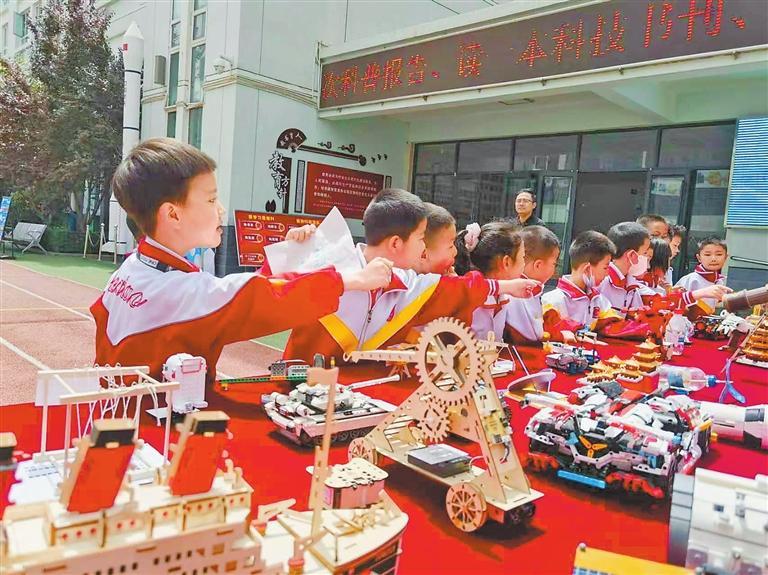
Shi Yanlong said that in the past three years, students have won more than 2,100 awards in various competitions at various levels, and science and technology clubs have won more than 10 first prizes in provincial and municipal model aircraft and robotics competitions. At the end of each semester, feedback from parent surveys shows that satisfaction with club activities has reached over 96%, with parents generally saying their children are more confident and cheerful than before.
To ensure the quality of club courses, some schools not only fully utilize the professional expertise of their teachers but also hire science and technology instructors and external experts to teach on campus, providing students with professional guidance.
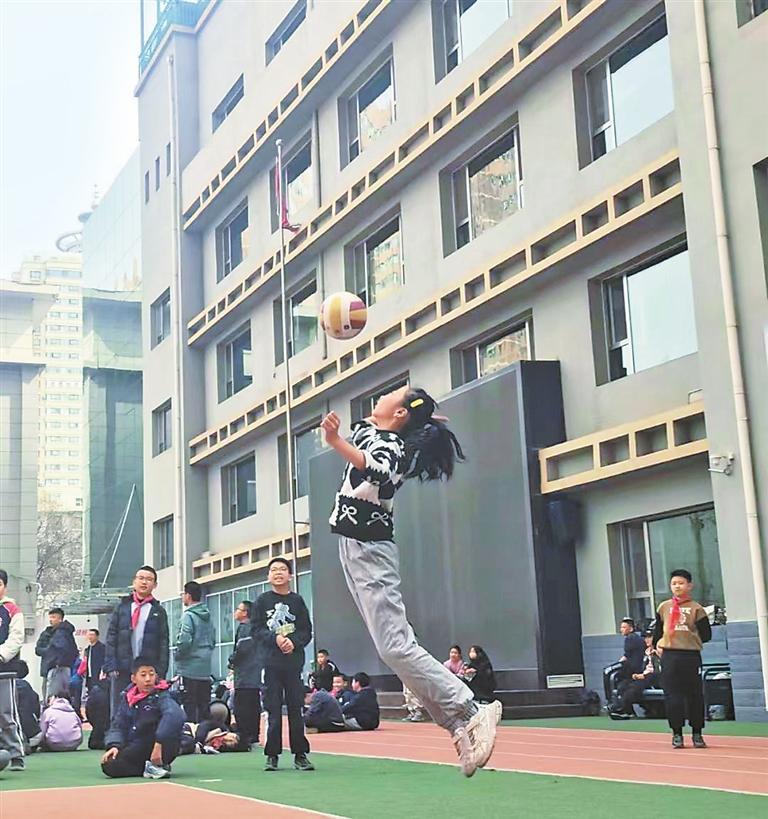
Changjia Lane Primary School organizes various types of club activities every week during extended service hours. Nearly 40 clubs such as volleyball, tie-dye, paper sculpture, and programming allow all students to learn and grow in different fields.
Lu Xiaoying, the full-time deputy secretary of the Changjia Xiang Primary School Party Branch, introduced that the school offers four different types of clubs: school-level, grade-level, class-based, and parent-child clubs. Parent-child clubs use parent sharing sessions, social practice, outdoor activities, and other forms to carry out story-sharing and housework activities; Class clubs fully tap into the strengths of teachers in each subject, offering interest courses such as handicrafts and classic recitation; Grade clubs and school-level clubs offer specialized courses such as choir, volleyball, model aircraft, and programming, with the aim of cultivating talent and taught jointly by teachers from inside and outside the school.
Lu Xiaoying told reporters that students from school-level clubs can also represent their schools in related competitions after selection. "The volleyball club has the largest number of members and often represents the school in various competitions. In 2024, we won 5th place in the boys' C group in the 'National Little Volleyball Championship Finals', further boosting students' enthusiasm for club activities. ”
Collaborative Education: Breaking Through the Campus 'Walls'
In recent years, more and more schools in Lanzhou have joined hands with various social resources to build diverse growth platforms for children, deeply integrating knowledge with practice, school with society.
Entering the first-grade classroom at Caochangjie Primary School, children are paired up to play Go—this is the Go class jointly established by the school and Gansu Chess Academy.
Go teacher Li Wenxia patiently guided the groups between the groups, "When the kids first arrived, they all had zero foundation, but now many can finish a full game." ”
Xiao Fang, principal of Caochangjie Primary School, told reporters that grades one and two offer Go and international chess courses respectively. At the end of the term, they hold grade- and school-level "Little Chess" competitions, which not only cultivate students' interest, help them learn to follow rules and improve concentration, but also stimulate their sense of competition and collective pride.
In recent years, Caochang Street Primary School has also organized students to visit university campuses, museums, libraries, hospitals, and other practical bases for learning, allowing children to grow through rich curriculum experiences.
At the Lanzhou Branch of the Chinese Academy of Sciences Primary School, each class has two special "mentors"—one academician and one science and technology instructor.
Most of these academicians are from Lanzhou or have worked in Lanzhou. Each class uses themed class meetings, material reading, and teacher explanations to help children get to know academicians and understand their research journeys. "I hope that by learning about the academician's story, I can plant the spirit of the academician in students' hearts." Chang Jike, Director of the Moral Education Office, said that the academicians' experiences of rooting themselves in the western region and overcoming difficulties are the most vivid teaching materials for educating children about patriotism.
while "science and technology counselors" are held by parents of students working in research institutes. Every semester, the "science instructors" regularly visit campus to give lectures and lead children in hands-on experiments, showcasing daily research work and helping children better understand their parents' work, bringing parents closer together.
The university also actively collaborates with various science museums, research institutions, and higher education institutions to carry out the "Science Enters Campus" activities. From popular science lectures to the annual campus science and innovation festival every May, a variety of activities bring children a series of "technology feasts."
Last year, during the Science and Technology Innovation Festival, the school set up nearly 20 experience points such as "Magical Flame in the Palm," "Angry Little Pufferfish," and "Levitation Magic," allowing children to learn a lot of scientific knowledge through fun challenges.
Study notes
Colorful classrooms for happy growth
If the youth are wise, the nation is wise; if the youth are strong, the nation is strong. A child's growth depends on learning and exploring the humanities, arts, and sciences.
As the old saying goes, "What is learned from books is always shallow; to truly understand it, one must practice it firsthand." Lanzhou's primary schools break the boundaries of traditional classrooms, allowing children to participate in military training, learn traditional culture, grow flowers and vegetables, and experience food making...... From national defense education that cultivates patriotism, to specialized courses that root knowledge, and to various clubs that unleash children's individuality, Lanzhou's primary schools have strengthened the main role of school education from multiple angles, allowing students to return to campus and education to its essence. Through various explorations, children have learned much knowledge that is hard to learn from textbooks. Society, families, and schools work together, with academicians, parents, and off-campus experts all becoming "education partners," jointly building a multidimensional network for children's growth.
Lanzhou's primary schools strive to break through the walls of the "standard answer," returning the world to children so that every child can grow up happily. When children become more confident and cheerful, parent-child and home-school relationships can become increasingly harmonious. (New Gansu · Gansu Daily reporter Wang Junjie)